

education, art & Communication
We share scientific results with communities to encourage their conservation efforts and their recognition as guardians of biodiversity. These approaches benefit the well-being of communities, the mitigation of human-wildlife conflicts and the development of sustainable activities such as ecotourism by promoting local biodiversity.

educational programs
Educational programs in schools and communities about local biodiversity
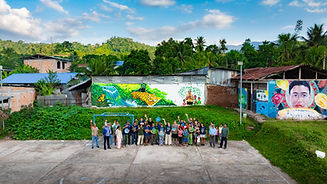
ART & STORIES
Art, stories and materials co-created with communities

scientific results
Scientific results shared with communities who lead conservation efforts

mitigating conflicts
Mitigating conflicts between humans and wildlife, towards coexistence
OUR METHODS AND ACTIONS
Highlighting local biodiversity in educational and school programs
While species that are often exotic or from distant lands tend to be highlighted, we develop educational materials and workshops that celebrate local biodiversity—whether common or rare—in order to rebuild connections between generations and with nature. Communities, as the guardians of their biodiversity, thus pass on their knowledge and the scientific findings from their work to their children.


Mitigation of Human-Wildlife Conflicts
By drawing on multidisciplinary expertise, we design and lead educational materials and workshops—for both adults and children—to reduce conflicts between humans and wildlife (e.g., venomous snakes, crocodiles). Through simple actions and best practices, many negative interactions can be prevented. These efforts improve the well-being and health of communities, while strengthening the conservation of declining species and promoting coexistence between humans and wildlife.


Share the scientific findings resulting from the work of local communities
We create spaces where communities have a voice, share their scientific findings, and put them to use in their projects. These initiatives foster a sense of local pride, highlight iconic species, and open up opportunities for ecotourism and marketing strategies for sustainable production.


A collaborative effort to develop methods and tools for promoting and defending cultural identities
Together with communities and our partners, we co-develop tools and workshops that are inclusive of and respectful toward different cultures and languages, while highlighting local expertise and knowledge. This approach strengthens the links between biodiversity, cultural identities, and traditional practices, which are essential to community-based conservation.


BROWSE OUR EDUCATION RESOURCES
Over the years, we have worked with our local partners to develop tools, resources, and methods that we have subsequently adapted and replicated from one region to another. Born out of dynamic exchanges between science, conservation, and local issues, these tools are unique, tailored to specific needs, and address clearly identified requirements.
Here are some examples:


COLORING BOOK ABOUT LOCAL BIODIVERSITY
A fun and educational resource that highlights the species observed in collaboration with local communities. Each on-site photograph is accompanied by educational information, followed by a coloring page to help children learn to identify the species.
Developed in Peru, replicated in Côte d’Ivoire, and coming soon to Taiwan!

CACAO AND BIODIVERSITY GAME
A dynamic, participatory game that raises children’s awareness of the importance of local biodiversity as a crop aid. Through play and sports, they learn in a fun way about ecosystem services and the close links between biodiversity conservation, sustainable agriculture, and community well-being.
Developed in Côte d’Ivoire and replicated in Peru!
POSTERS ABOUT COEXISTENCE BETWEEN SNAKES AND HUMANS
Clear and engaging posters to help people learn to identify venomous snakes, minimize the risk of bites, and understand their ecology and their crucial role in ecosystems and for humans, with the aim of promoting coexistence and reducing conflicts.
Designed in Peru, and already replicated in Côte d’Ivoire and Cambodia.


ALL EDUCATIONAL MATERIAL
%20(1).png)
Ecotourism modules